That Little Yellow Lever: A Frank Talk About Sea-Doo Safety
It's a perfect summer afternoon on the lake. The sun is high, the water is sparkling, and you've got a full tank of gas. You squeeze that little yellow lever on your Sea-Doo, and in a heartbeat, you're flying across the water at 60 miles per hour.

Dwayne Rodrigues
Boat Owner & Enthusiast
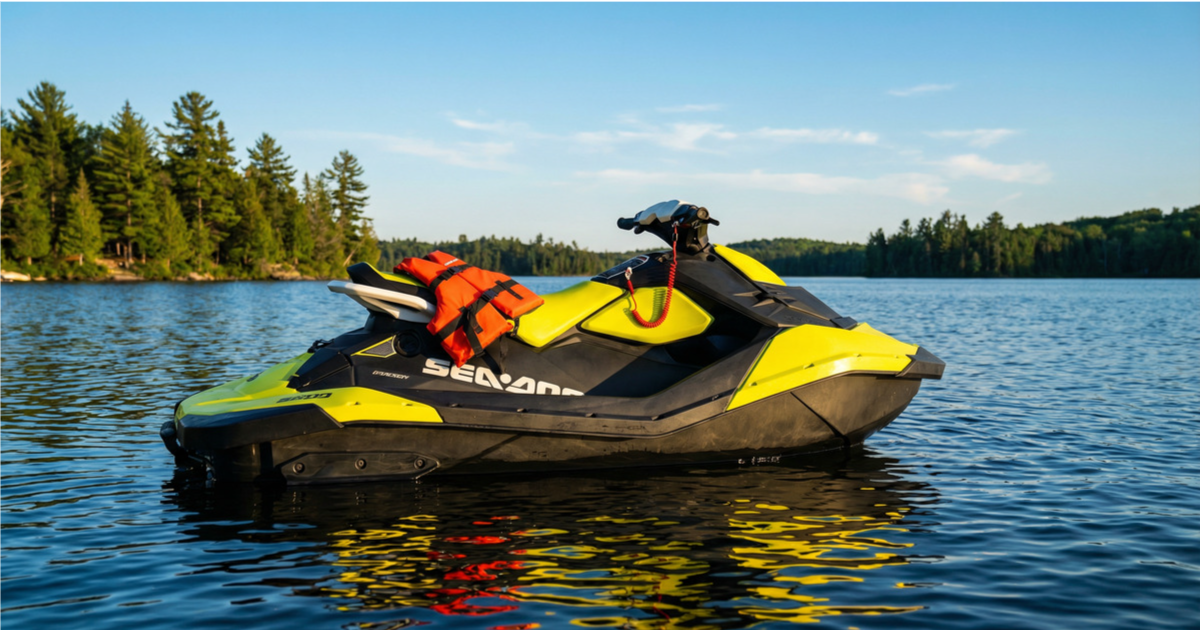
It's a perfect summer afternoon on the lake. The sun is high, the water is sparkling, and you've got a full tank of gas. You squeeze that little yellow lever on your Sea-Doo, and in a heartbeat, you're flying across the water at 60 miles per hour. It's a feeling of pure freedom, a mix of adrenaline and joy that's hard to beat. But here's the thing we need to talk about, rider to rider: that feeling of invincibility is an illusion. One moment of distraction, one bad decision, and that freedom can turn into a nightmare.
We've all seen it. The rider who zips a little too close to a fishing boat, the one who misjudges a wake and gets thrown, or the group that's so focused on having fun they forget to watch where they're going. Most of the time, it ends with a laugh and a story. But sometimes, it doesn't. This isn't about fear-mongering; it's about respect. Respect for the machine, for the water, and for everyone else out there trying to enjoy their day. We're going to get into the nitty-gritty of personal watercraft (PWC) safety, looking at real-life incidents and what we can learn from them to make sure every ride ends as it should: with a smile and plans for the next one.
Quick Takeaways: Your PWC Safety Checklist
Operator Inattention is Deadly: Looking back at a tuber or being distracted for even a few seconds can lead to a fatal collision with a fixed object or another boat. Always have a dedicated spotter.
Know Your Distance: Maintain a safe speed and distance from other boats, people, and shorelines. Most collisions are avoidable with better situational awareness.
Wear Your PFD: A lifejacket only works if you wear it. 89% of boating-related drowning victims were not wearing one. Don't become a statistic.
Hospitalization is Common: PWC accidents have a hospitalization rate four times higher than other injury types, with head, leg, and internal injuries being frighteningly common.
Weekends are Prime Time for Accidents: Most injuries happen on weekend afternoons in the summer. Be extra vigilant during these peak hours.
The Headline You Never Want to Be
In August 2025, on a sunny Thursday afternoon on Lake St. Clair, a group of teenagers were out on a jet ski, pulling a friend on a tube. It's a scene that plays out on countless Canadian lakes every summer. But this time, it ended in tragedy. According to a CBC News report, the operator appeared to be looking back at the tube, worried about her friends. She came in too close to the shore and hit a concrete breakwall at top speed. A 17-year-old girl was killed, and another was left with critical, life-altering injuries.
This wasn't a freak accident. It was a textbook case of how quickly things can go wrong. The official Transport Canada Safe Boating Guide rule for towing is clear: you must have a dedicated spotter on board, facing the person being towed, and an empty seat for every person you're pulling. The driver's job is to look forward. Period. That single, devastating incident highlights the number one cause of PWC accidents: operator inattention.
It's not just about towing. In another incident reported by CP24, a man in his 30s was hospitalized after a collision on Lake Ontario. In Lake Superior, two youths were injured when their jet skis collided, resulting in the owner being ticketed by the OPP, as noted by TBNewsWatch. These aren't just news stories; they are cautionary tales happening in our own backyards.
More Than Just a Flesh Wound: The Hard Numbers on PWC Injuries
If the headlines aren't enough to get your attention, the data should be. An older but still relevant study from the Public Health Agency of Canada's CHIRPP database painted a stark picture of PWC injuries. The single most shocking statistic? The rate of hospital admission for PWC-related injuries is four times higher than the average for all other types of injuries recorded in the database. When things go wrong on a PWC, they go very wrong.
What kind of injuries are we talking about? It's not just scrapes and bruises.
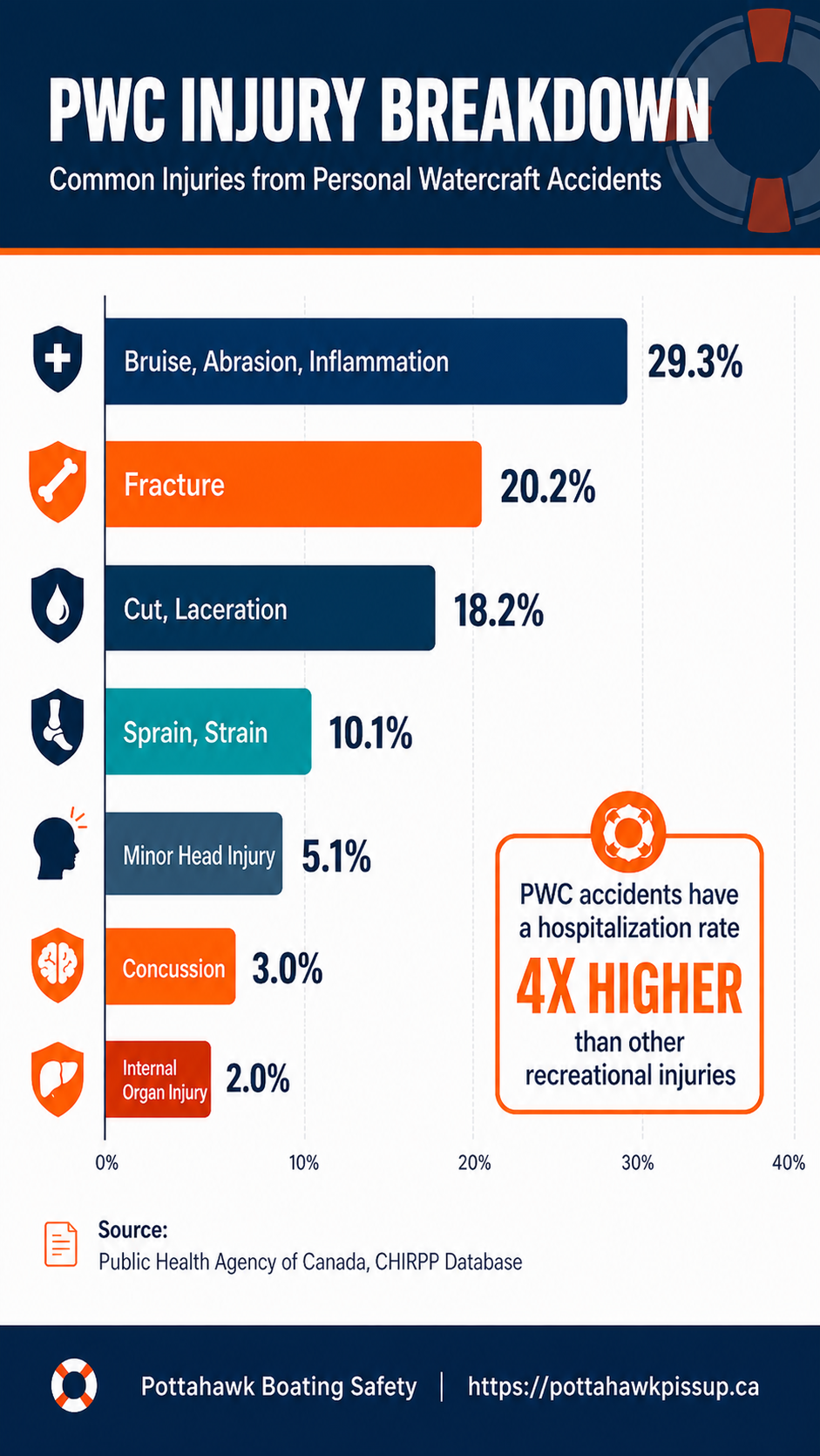
The most commonly injured body part is the head or neck, making up a third of all injuries. Think about that. Hitting the water, or another object, at 50 mph is like hitting concrete. The forces involved are immense, and the human body is fragile. Fractures to the upper leg and face are also common, often a result of being thrown into the handlebars or colliding with another object.
The circumstances tell a story too. Nearly 30% of all PWC injuries happen when riders hit against or get caught in their own watercraft after falling off. Another 28% involve collisions with other PWCs or fixed objects. These aren't random acts of bad luck. They're the result of speed, inexperience, and a lack of awareness. The good news is that means they're preventable.
Your PWC Safety Playbook: How to Not Be That Guy
Alright, enough with the grim statistics. The point isn't to scare you off the water; it's to make you a smarter, safer rider. Being safe isn't about being boring. It's about being professional, being in control, and ensuring the fun can last a lifetime.
1. The Pre-Ride Ritual
Before you even touch the throttle, your safety check begins. This isn't just for airplanes. Check your fuel and oil levels. Give the craft a once-over for any visible damage. Make sure your steering is responsive. And for the love of all that is holy, ensure your engine cut-off lanyard is attached to you. If you fall off, and you will, that's the only thing stopping your 700-pound machine from becoming an unguided missile.
Look at your required safety equipment. According to Transport Canada, you need a Canadian-approved lifejacket or PFD for every person on board. You also need a buoyant heaving line at least 15 metres long, a sound-signaling device like a whistle or horn, and a reboarding device if your freeboard is more than half a metre. If you're operating after sunset, you need navigation lights and a watertight flashlight or flares. Don't just have this stuff on board. Know where it is and how to use it.
2. Situational Awareness is Everything
Remember the Lake St. Clair tragedy. The operator was distracted. When you're driving, you have one job: look where you are going. This means constantly scanning your surroundings. Look for other boats, swimmers, paddleboarders, and fixed objects like docks and buoys. As we've discussed in our guide to safely attending large boat raft-ups, crowded areas demand slower speeds and heightened awareness. A PWC's agility can be its greatest asset, but it can also get you into trouble faster than you can react if you're not paying attention.
Here's a reality check. Most PWC injuries happen between noon and 8 PM on summer weekends. That's when the water is busiest. If you're out on a Saturday afternoon in July, you need to dial your awareness up to eleven. Slow down. Give other boats a wide berth. Assume that swimmers and paddlers can't see or hear you coming.
3. The PFD: It's Not a Seat Cushion
Let's be blunt. If you're not wearing your lifejacket, you're an idiot. Transport Canada data shows that nearly 90% of recreational boaters who drown are not wearing a PFD. A PFD stored under your seat is useless when you're unconscious in the water. Modern PFDs designed for PWC use are comfortable, lightweight, and allow for a full range of motion. There is simply no excuse. The data also shows that passengers are 46 times more likely to wear a PFD if the operator is. Be the leader. Set the example.
Think about what happens when you fall off at speed. You hit the water hard. If you're lucky, you're just winded. If you're not, you're disoriented, possibly injured, and struggling to stay afloat. That bright orange vest is the difference between a quick rescue and a tragedy. Wear it. Every time. No exceptions.
4. Respect the Rules (They're Not Suggestions)
Yes, you need your Pleasure Craft Operator Card (PCOC) to operate any powered watercraft in Canada, including a Sea-Doo. This isn't just a piece of plastic; it's proof that you've learned the basic rules of the road on the water. As we covered in our post on the new 2026 boat licence changes, these regulations are serious. Beyond that, obey no-wake zones, respect speed limits, and understand the right-of-way rules. It's the foundation of a safe boating community.
One rule that gets ignored constantly: maintaining a safe distance. In Ontario, you must stay at least 30 metres away from a shoreline, dock, or anchored boat when travelling faster than 10 km/h. You also can't operate within 30 metres of a swimmer or someone in a non-motorized boat. These aren't arbitrary numbers. They're based on reaction time, stopping distance, and the wake your PWC creates. Violate them, and you're not just being rude. You're being dangerous.
PWCs and Raft-Ups: A Recipe for Disaster (If You're Not Careful)
If you're heading to an event like Pottahawk, where hundreds of boats tie up together in a massive floating party, you need to understand that your PWC changes the game. You're faster, more agile, and way more annoying than you think you are. The wake you throw, even at moderate speeds, can rock a raft-up and send drinks flying, or worse, knock someone into the water.
When approaching a raft-up, slow down well in advance. We're talking idle speed, maybe 5 km/h. Your job is to blend in, not make an entrance. If you're planning to tie up to the raft, do it on the outside edge, never in the middle. PWCs sit low in the water and can get swamped or damaged when larger boats shift. More importantly, you need a quick exit route in case of an emergency or if you need to leave.
Our article on the art of the raft-up goes into detail about proper etiquette and safety, but the short version for PWC riders is this: be respectful, be slow, and be aware that you're the smallest, most vulnerable craft out there. If the raft-up is packed and there's no safe spot, anchor nearby and swim over. It's not worth the risk.
Common Mistakes (And How to Avoid Them)
Let's talk about the dumb stuff we all do, or are tempted to do, and why it's a bad idea.
Riding Too Close to Other Boats. You think you're being friendly or showing off your skills. What you're actually doing is creating a collision risk. Give other boats space. If they're fishing, give them even more space. Your wake can tangle lines and ruin their day.
Jumping Wakes. It looks cool. It feels cool. It's also a great way to lose control, get thrown, or land on someone. Wakes are unpredictable. The boat that created it might turn, leaving you airborne and heading straight for them. If you're going to jump wakes, do it in open water, far from other traffic.
Operating After Dark Without Proper Lights. This one is just plain stupid. You can't see, and no one can see you. If you absolutely must operate after sunset, make sure your navigation lights are working and you have a flashlight. Better yet, don't. PWCs and darkness are a bad combination.
Ignoring Weather Conditions. A calm lake can turn into a nightmare in minutes. High winds, lightning, and rough water are all reasons to head back to shore. PWCs are small and light. They get tossed around in conditions that larger boats can handle. Check the forecast before you go out, and keep an eye on the sky while you're on the water. Our Lake Erie boating safety guide has detailed information on reading weather patterns and knowing when to call it a day.
What to Do When Things Go Wrong
Despite your best efforts, accidents happen. Knowing what to do in an emergency can save your life or someone else's.
If You Fall Off: First, don't panic. Your PFD will keep you afloat. Look for your PWC. If the engine cut-off lanyard worked, it should be nearby, engine off. Swim to it and use the reboarding device to climb back on. If the engine is still running (which means the lanyard failed or wasn't attached), stay away from the back. The jet intake can cause serious injury.
If Someone is Injured: Get them out of the water if it's safe to do so. Call for help immediately. In Ontario, marine emergencies are handled by the OPP or Coast Guard. Use your cell phone if you have signal, or use a VHF radio if you have one. Provide your location as accurately as possible. If the person is unconscious or not breathing, start CPR if you're trained.
If You Witness a Collision: Stop and render assistance if you can do so safely. You are legally required to help in a boating accident. Get the injured to shore or to a larger boat if possible. Document what you saw. Your account could be important for investigators.
A Final Word
Operating a personal watercraft is one of the great joys of summer in Canada. It's fast, it's thrilling, and it's an incredible way to experience our beautiful lakes and rivers. But that power and speed come with a heavy responsibility. The stories and statistics aren't meant to take the fun away. They're meant to ground it in reality. By being prepared, staying aware, and respecting the rules, you're not just protecting yourself. You're protecting the families in the pontoon boat nearby, the kids swimming off the dock, and the future of this sport we all love.
So, the next time you're out on the water, take a moment before you squeeze that throttle. Look around, clip on your lanyard, and make a conscious decision to be a safe, responsible rider. The best stories are the ones you live to tell.
Sources & Further Reading
CBC News (August 15, 2025). Jet ski in deadly Lake St. Clair crash was pulling a tube, police say.
Transport Canada (March, 2024). Safe Boating Guide (TP 511E).
CP24 (August 4, 2025). Man in his 30s in hospital following jet ski collision in Lake Ontario.
TBNewsWatch (July 22, 2025). Jet ski owner ticketed after collision on Lake Superior.
Tags
Share
Read Next
 Safety
Marine Emergencies: A Complete Guide to On-Water Incidents
There is a moment every boater dreads. You are cruising along, enjoying the sun and the water, when suddenly the engine cuts out, smoke starts billowing from the hatch, or someone slips and falls over the rail. In that split second, the peaceful day on the

Dwayne Rodrigues
Boat Owner & Enthusiast
 Safety
Do You Need a Boating Licence in Canada?
If you are planning to spend any time on the water this summer, you have probably asked yourself the big question: do you need a boating licence in Canada? The short answer is yes. If your boat has a motor, you need a licence.
Dwayne Rodrigues
Boat Owner & Enthusiast
 Safety
How to Avoid Running Aground: A Boater's Guide to Shallow Water Safety
Running aground is one of those boating experiences that ranges from a minor, face-reddening embarrassment to a catastrophic emergency. One minute you are cruising along enjoying the sun, and the next, there is a sickening crunch, a sudden stop, and every
Dwayne Rodrigues
Boat Owner & Enthusiast