The Ultimate Lake Erie Boating Safety Guide
Lake Erie is one of those places that can make you fall in love with boating all over again. The water sparkles on a sunny day, the fishing is world-class, and there is something about being out on one of the Great Lakes that just feels different.

Dwayne Rodrigues
Boat Owner & Enthusiast
Quick Takeaways
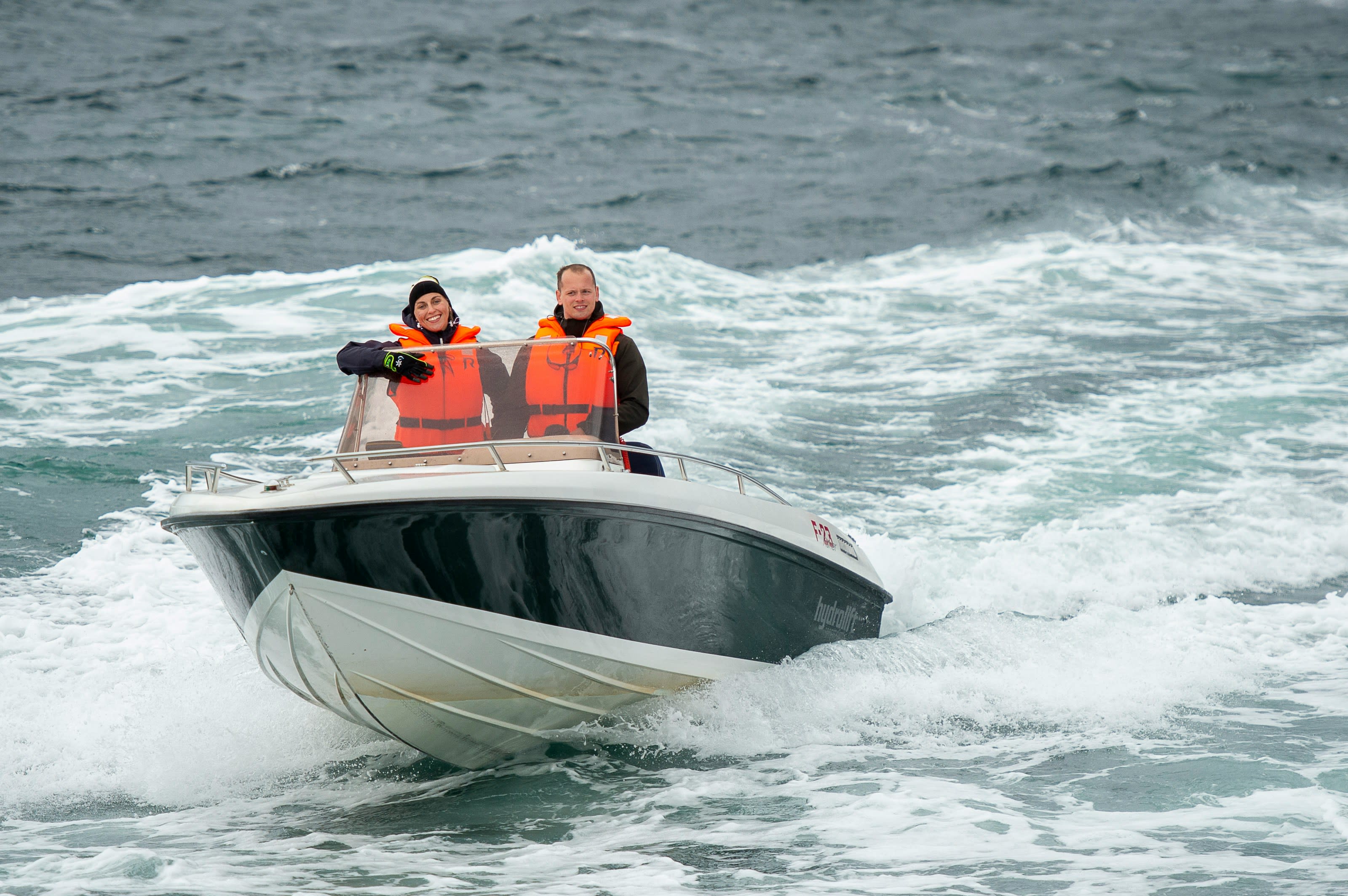
Lake Erie's shallow depth makes it uniquely dangerous. Waves build incredibly fast, and a phenomenon called a "seiche" can cause rapid, unpredictable water level changes. This guide covers everything from mandatory Transport Canada safety equipment and the dangers of impaired boating to navigating at night, understanding marine forecasts, and handling the specific challenges of events like the Pottahawk Pissup. Key takeaways: always check the marine forecast, carry more safety gear than required, understand the risks of cold water, and never underestimate how quickly this Great Lake can turn on you.
Why Lake Erie Demands Your Respect
Lake Erie is one of those places that can make you fall in love with boating all over again. The water sparkles on a sunny day, the fishing is world-class, and there is something about being out on one of the Great Lakes that just feels different. It is a boater's paradise, dotted with incredible destinations from the Pelee Island wineries to the iconic Pottahawk sandbar. But here is the thing every seasoned Erie boater knows: this lake demands respect. It is not a lake you can take lightly, and if you are not prepared, it can turn dangerous in a hurry.
This guide is designed to be the most comprehensive resource for staying safe while enjoying everything Lake Erie has to offer. We will go deep on the unique conditions you will encounter, the mandatory safety equipment you are required to have on board, and the practical skills for handling emergencies and making smart decisions on the water. Whether you are a first-time boater or a seasoned captain, consider this your essential pre-launch checklist.
The Science of Erie: Shallow, Dangerous, and Unpredictable
Let us start with what makes Lake Erie special, and by special, I mean both wonderful and potentially treacherous. Lake Erie is the shallowest of the Great Lakes, with an average depth of just 62 feet. Compare that to Lake Superior, which averages over 480 feet, and you start to see why Erie behaves so differently. As we cover in our post on how fast the Great Lakes can turn dangerous, this shallow depth is the primary reason for the lake's volatility.
That shallowness means the water warms up faster in the summer, which is great for swimming and water sports. But it also means that waves can build up incredibly quickly when the wind picks up. There is not much depth for the wind's energy to dissipate into, so it all goes into creating steep, choppy, square waves that can catch even experienced boaters off guard. The lake does not give you much warning. A calm morning can become a genuinely dangerous afternoon in the time it takes to eat lunch. This is not an exaggeration. It is a well-documented characteristic of the lake that has caught countless boaters by surprise over the years.
Lake Erie is widely regarded as one of the most unpredictable of the Great Lakes for boaters, largely because of its orientation. The lake runs roughly southwest to northeast, which means it is perfectly aligned to funnel the prevailing westerly winds straight down its length. When those winds pick up, they have hundreds of kilometres of open water to build waves over. The result is that Lake Erie can generate waves that are disproportionately large for a lake of its size. Waves of two to three metres are not uncommon during strong wind events, and they arrive much faster than you would expect.
The Seiche Effect: When the Lake Tilts
One of the most dramatic and dangerous phenomena on Lake Erie is the seiche (pronounced "saysh"). A seiche is essentially the entire lake tilting. When a strong, sustained wind blows from one end of the lake to the other, typically southwest to northeast, it piles up water on the downwind side. This can cause water levels in places like Buffalo, New York, to rise by several feet in a matter of hours. Conversely, on the upwind side, around Toledo, Ohio, and the western basin, water levels can drop dramatically, exposing sandbars, reefs, and other navigational hazards that are normally safely underwater.
According to the National Park Service, these rapid water-level swings can create dangerous currents and coastal flooding. For boaters, a seiche can be a nightmare. It can leave you stranded in a marina with no water to get out, or it can create dangerously low water levels over areas you thought were safe to navigate. It is a powerful reminder that Lake Erie is a dynamic system that must be constantly monitored.
The most famous seiche event on Lake Erie occurred in November 1954, when a powerful storm caused water levels in Buffalo to rise by nearly five feet in just a few hours, flooding waterfront streets and causing significant damage. While that was an extreme event, smaller seiches happen several times a year. Monitoring the Environment and Climate Change Canada marine forecast will give you advance warning of the wind conditions that can trigger them.
Decoding the Weather: Your First Line of Defence
Given the lake's volatility, your first and most important safety tool is a reliable marine weather forecast. Do not just look at the general forecast for the city. You need the specific marine forecast from a source like Environment and Climate Change Canada. This will give you wind speed and direction, wave height predictions, and any active warnings or advisories.
Pay close attention to the wind direction. Onshore winds, blowing from the lake toward the shore, will build waves and push you toward land, which can be dangerous if your engine fails. Offshore winds, blowing from the land out over the lake, can be deceptive. The water near the shore might look perfectly calm, but as you head out into open water, you could encounter much rougher conditions. This is how many boaters get into trouble.
The wind speed thresholds to watch are straightforward. Environment and Climate Change Canada issues marine forecasts with specific wind warnings. A Strong Wind Warning is issued for winds of 20 to 33 knots, which calls for caution and good seamanship. A Gale Warning is issued for winds of 34 to 47 knots, and for most recreational boats, that means staying in port. It is not worth the risk.
Always have a plan for where you will seek shelter if the weather turns. Our Long Point Bay Boater Navigation Guide highlights some of the key safe harbours in that area, but you should know the safe spots all along your intended route. Before you leave the dock, identify at least two or three places where you could pull in quickly if conditions deteriorate. Know the depths of the entrances to those harbours, because a seiche could have changed the water levels since you last checked.
Gearing Up: Transport Canada's Mandatory Safety Equipment
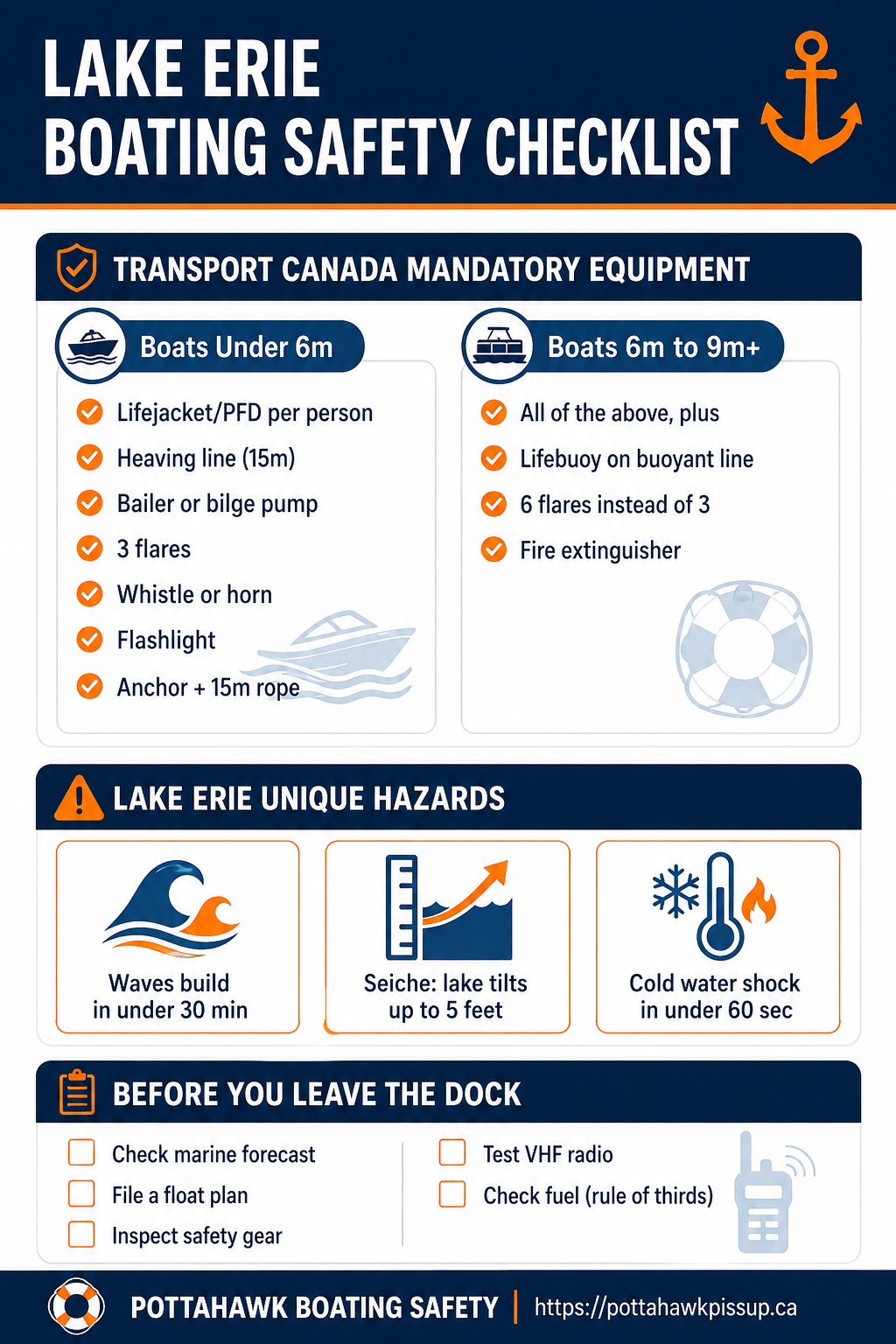
If you are boating on the Canadian side of Lake Erie, you must follow the safety equipment requirements detailed in Transport Canada's Safe Boating Guide. These are the minimum legal requirements, and failing to have the proper equipment on board can result in hefty fines. More importantly, having the right gear can save your life in an emergency.
As Transport Canada advises, "You are required by law to have a lifejacket or PFD on board for each person on a pleasure craft. There are no exceptions." Let us break down the requirements by boat size.
Boats Up to 6 Meters (19'8")
This category includes most small fishing boats, runabouts, and dinghies. Here is what you are required to have on board at all times:
Personal Lifesaving Appliances: One Canadian-approved lifejacket or PFD for every person on board, a buoyant heaving line at least 15 metres long, and a reboarding device if your boat's freeboard is over 0.5 metres.
Vessel Safety Equipment: A manual propelling device like a paddle, or an anchor with at least 15 metres of rope, and a bailer or manual bilge pump.
Visual Signals: A watertight flashlight and three pyrotechnic distress signals, which are flares.
Navigation Equipment: A sound-signaling device like a whistle or horn, navigation lights if you are out after dark, a magnetic compass if you are going out of sight of land, and a radar reflector.
Fire Fighting Equipment: A 5BC fire extinguisher if you have an inboard engine, a fixed fuel tank, or any fuel-burning appliances.
Boats Over 6 Meters and Up to 9 Meters (19'8" to 29'6")
This size range covers many popular family cruisers and day boats. The requirements are similar, but with a few additions:
Personal Lifesaving Appliances: In addition to the lifejackets and heaving line, you need either a buoyant heaving line or a lifebuoy attached to a buoyant line that is at least 15 metres long.
Visual Signals: You need six pyrotechnic distress signals instead of three.
Fire Fighting Equipment: You need a 5BC fire extinguisher if your boat has a motor, and another one if you have any fuel-burning appliances.
Beyond the Minimum: Gear That Actually Saves Lives
The legal minimum is not enough. It is a starting point. A well-equipped boat carries more. Consider adding these to your kit:
A VHF Radio: Cell phones are unreliable on the water. A VHF radio is your direct line to the Coast Guard and other boaters. It is the single most important piece of safety equipment you can own beyond the legal requirements.
A Good First-Aid Kit: Go beyond the basic kit. Include items for seasickness, burns, and serious bleeding.
An EPIRB or PLB: An Emergency Position-Indicating Radio Beacon or Personal Locator Beacon sends a distress signal with your exact location to search and rescue services. For anyone venturing far from shore, it is a potential lifesaver.
Electronic Flares: As we discuss in our article on electronic flares vs. traditional flares, modern electronic flares are a reliable, reusable alternative to pyrotechnics.
Navigation and Hazards: More Than Just Water
Lake Erie's bottom is not a flat, sandy plain. It is a complex landscape of reefs, shoals, and shipwrecks that can pose serious navigational hazards, and the combination of shallow water and heavy recreational traffic makes careful navigation essential.
The Underwater Graveyard: Shipwrecks and Reefs
According to History.com, there are an estimated 1,500 to 2,000 shipwrecks in Lake Erie, earning it the nickname "the underwater graveyard." While many of these are in deep water and are popular diving destinations, some are in surprisingly shallow areas and can be a genuine danger to navigation. Always consult up-to-date nautical charts before heading out, and use a good quality GPS chartplotter with a depth sounder. Do not rely solely on memory or outdated paper charts.
The Canadian Hydrographic Service publishes regularly updated charts for Lake Erie, and these are available in both paper and electronic formats. If you are using a chartplotter, make sure your charts are updated to the latest version. Shoals and sandbars can shift, and a chart that was accurate two years ago may not reflect current conditions.
Night Boating on Lake Erie: A Different World
Boating at night on Lake Erie is a completely different experience, and it comes with a unique set of risks. As we detail in our post on night boating risk on Lake Erie, your visibility is dramatically reduced, making it much harder to spot floating debris, unlit buoys, or other boats. Your navigation lights must be in perfect working order, and you should reduce your speed significantly.
Before heading out at night, do a full check of all your navigation lights. White stern light, red port light, green starboard light, and a white masthead light if required for your vessel type. Know the rules of the road for night navigation, including the right-of-way rules and what the light configurations of other vessels mean. A vessel showing a red light over a white light, for example, is a vessel engaged in fishing. Knowing these signals can prevent a collision.
The Human Factor: Critical Safety Decisions
All the safety gear in the world will not help if you make poor decisions. The human factor is the most common element in boating accidents, and it is the one area where every captain has complete control.
Impaired Boating: The Sobering Reality
In Canada, operating a boat while impaired by alcohol or drugs is a criminal offense with serious penalties. According to the Canadian Safe Boating Council, alcohol is a factor in nearly 40% of boating incidents. The sun, wind, and motion of the boat amplify the effects of alcohol significantly. A person who feels only mildly affected after two drinks on land may be substantially impaired on the water.
The legal blood alcohol limit for operating a vessel in Canada is the same as for driving a car: 0.08. But impairment begins well below that level. There is no excuse for impaired boating. If you are the captain, you are responsible for the lives of everyone on board. Designate a sober skipper, the same way you would a designated driver, and stick to it. The penalties for impaired boating include fines, licence suspension, and imprisonment.
Raft-Up Safety: The Pottahawk Edition
Events like the Pottahawk Pissup are a huge part of the Lake Erie boating culture. Hundreds of boats rafting together on the Long Point Bay sandbar is one of the most unique and memorable experiences the lake has to offer. But rafting up hundreds of boats together creates a unique set of safety challenges that every participant needs to understand. Our guide on how to safely attend large boat raft-ups goes into great detail, but the key principles are worth summarising here.
The anchor is everything. The lead boat's anchor holds the entire raft, and if it drags, every boat in the raft moves with it. The anchor must be oversized for the conditions and the size of the raft, and it must be properly set before any other boats attach. Our post on anchor failure scenarios and prevention is essential reading before you attend any large raft-up event. Approach and leave the raft-up at idle speed, no exceptions. Use plenty of large fenders to protect your boat and your neighbours'. And always have an exit plan: know how you will detach from the raft if the weather turns or an emergency occurs.
Cold Water Kills: Understanding Hypothermia
Even on a hot summer day, the water in Lake Erie can be dangerously cold. In early summer, water temperatures in the deeper parts of the lake can still be in the low teens Celsius, even when the air temperature is in the high twenties. A fall overboard can lead to hypothermia in a surprisingly short amount of time.
The initial shock of cold water immersion can cause involuntary gasping and hyperventilation, which can lead to inhaling water and drowning before hypothermia even sets in. This is called cold water shock, and it is the primary cause of death in many cold water drowning incidents. Always wear a lifejacket. It will keep you afloat and help conserve body heat. If someone does fall in, the priority is to get them out of the water as quickly and safely as possible. Do not let them try to swim to the boat. Throw them a line or bring the boat to them.
Emergency Preparedness: Your Plan B
No one wants to think about things going wrong, but being prepared can make all the difference between a bad day and a tragedy.
Filing a Float Plan
A float plan is a simple document that outlines the details of your trip. You leave it with a responsible person on shore, and if you do not return on time, they can alert the authorities. A good float plan includes your vessel name and description, the names and contact information of everyone on board, your departure point and destination, your intended route, your expected return time, and the emergency contact numbers for the Canadian Coast Guard.
Transport Canada provides a float plan form that you can download and fill out before every trip. It only takes a few minutes, and it could save your life. The Canadian Coast Guard's search and rescue response is significantly faster when they have a float plan to work from.
The VHF Radio: Your Lifeline
A VHF radio is essential. Channel 16 is the international distress and calling channel, and it is monitored by the Canadian Coast Guard and other vessels at all times. Know how to use it to make a Mayday call. The format is straightforward: "Mayday, Mayday, Mayday. This is [vessel name], [vessel name], [vessel name]. My position is [GPS coordinates or description]. I am [nature of distress]. I have [number of people on board]. I require immediate assistance." Repeat until you get a response.
You will also need a Restricted Operator's Certificate (Maritime) to legally operate a VHF radio in Canada. The course is short and inexpensive, and it is absolutely worth doing. It covers not just the Mayday procedure but also the full range of VHF communications, including how to receive weather broadcasts on the dedicated weather channels.
Fuel Planning and Mechanical Preparedness
One of the most common causes of distress calls on Lake Erie is running out of fuel. It sounds almost embarrassingly simple, but it happens constantly, especially on long weekend events when marinas are busy and fuel docks have lineups. The rule of thirds is your friend here: use one third of your fuel to get to your destination, keep one third for the return trip, and hold one third in reserve for emergencies. If you are planning a longer trip, our post on fuel planning for a long weekend on the water walks through the calculations in detail.
Beyond fuel, a pre-departure mechanical check should be part of every outing. Check your engine oil and coolant levels. Inspect your belts and hoses for wear. Test your bilge pump. Check that your battery is fully charged and your connections are clean. Look at your propeller for any dings or damage that could cause vibration. These checks take ten minutes and can prevent hours of frustration on the water.
Carry a basic toolkit on board. A set of screwdrivers, pliers, adjustable wrench, electrical tape, spare fuses, and a few spare belts can get you out of a lot of minor mechanical situations. A can of WD-40 and some marine grease are also worth having. The goal is not to become a mechanic on the water, but to handle the small stuff so that a minor issue does not become a major emergency.
Understanding Right of Way on Lake Erie
Knowing the rules of the road on the water is not just a legal requirement, it is a fundamental safety skill. The Collision Regulations, which are Canada's version of the International Regulations for Preventing Collisions at Sea (COLREGs), govern who has the right of way in any given situation. Here are the basics that every Lake Erie boater should know.
A vessel under sail generally has the right of way over a vessel under power, unless the sailing vessel is overtaking the power vessel. A vessel that is restricted in its ability to manoeuvre, such as a vessel engaged in fishing with nets or a vessel constrained by its draught, has the right of way over most other vessels. When two power vessels are approaching head-on, both must turn to starboard (right) to pass port-to-port. When two power vessels are crossing, the vessel on the starboard (right) side has the right of way and is the stand-on vessel. The other vessel is the give-way vessel and must take early and obvious action to avoid a collision.
At large events like Pottahawk, the sheer number of vessels in a small area makes right-of-way situations complex and fast-moving. The best approach is to slow down, keep a sharp lookout in all directions, and give way generously even when you technically have the right of way. The goal is to avoid collisions, not to win arguments about who had the right of way.
Conclusion: Respect the Lake
Lake Erie is an incredible place to boat, and with the right preparation and mindset, you can enjoy it safely for a lifetime. The key is to respect the lake, understand its unique characteristics, and be prepared for the unexpected. From checking the weather before you leave the dock to having the right gear on board and making smart decisions throughout the day, safety is an active and ongoing process.
The boating community on Lake Erie is a welcoming and passionate one. Events like the Pottahawk Pissup are a testament to that. But the best captains are the ones who take their responsibility seriously, who know the rules, carry the gear, and make the call to stay in port when conditions are not right. By taking safety seriously, you can ensure that every trip on Lake Erie is a good one, and that you and your crew come home safely every time.
Sources & Further Reading
Transport Canada: Safe Boating Guide
Transport Canada: Filing a Trip Plan
Government of Canada, Department of Justice: Impaired Operation of a Conveyance
Canadian Safe Boating Council: Operation Dry Water
Environment and Climate Change Canada: Marine Weather for Great Lakes
Canadian Hydrographic Service: Wreck Information
National Park Service: Coastal Geohazards: Seiches
Canadian Hydrographic Service: Nautical Charts for Lake Erie
Tags
Share
Read Next
 Safety
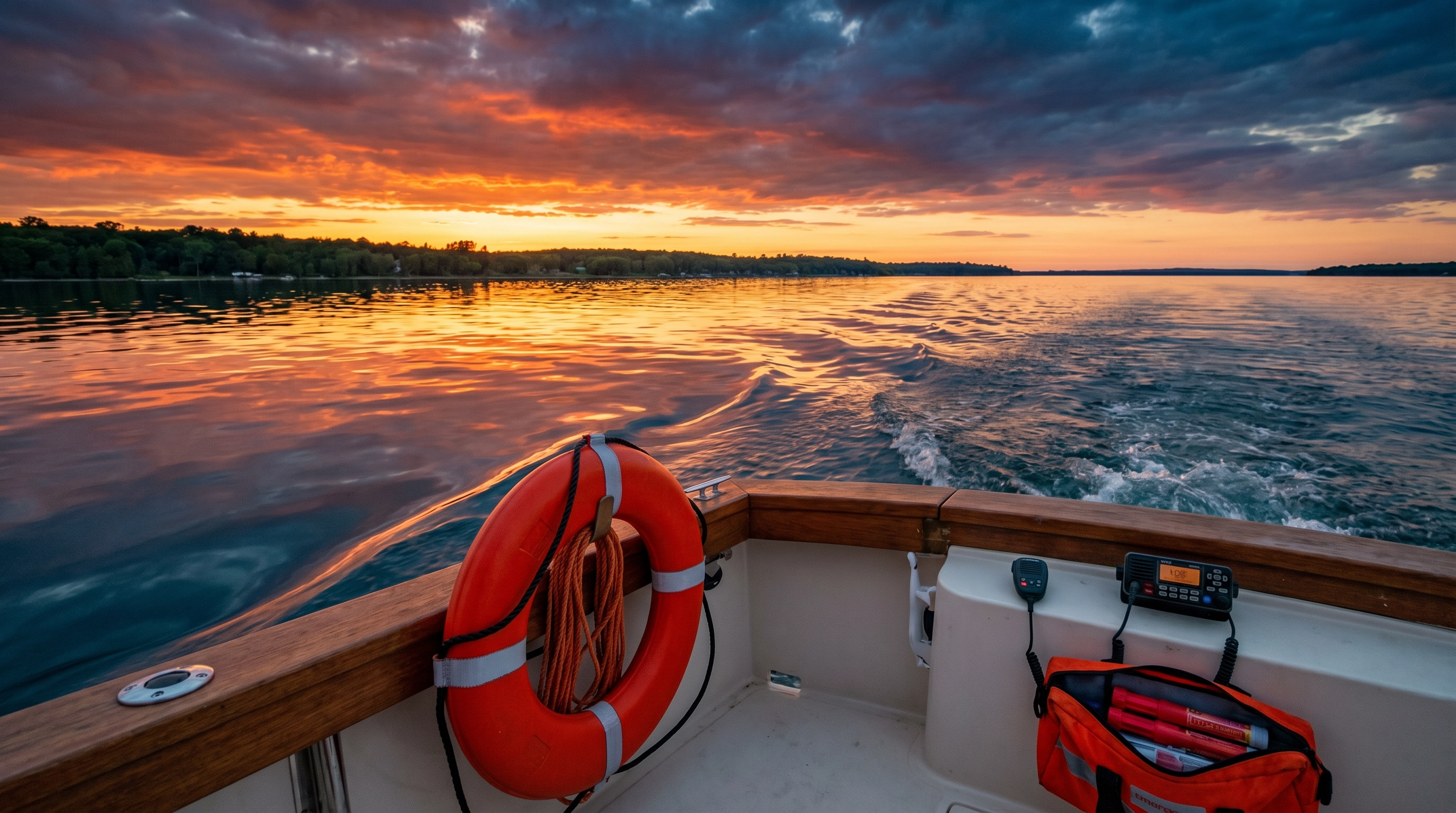
Marine Emergencies: A Complete Guide to On-Water Incidents
There is a moment every boater dreads. You are cruising along, enjoying the sun and the water, when suddenly the engine cuts out, smoke starts billowing from the hatch, or someone slips and falls over the rail. In that split second, the peaceful day on the

Dwayne Rodrigues
Boat Owner & Enthusiast
 Safety
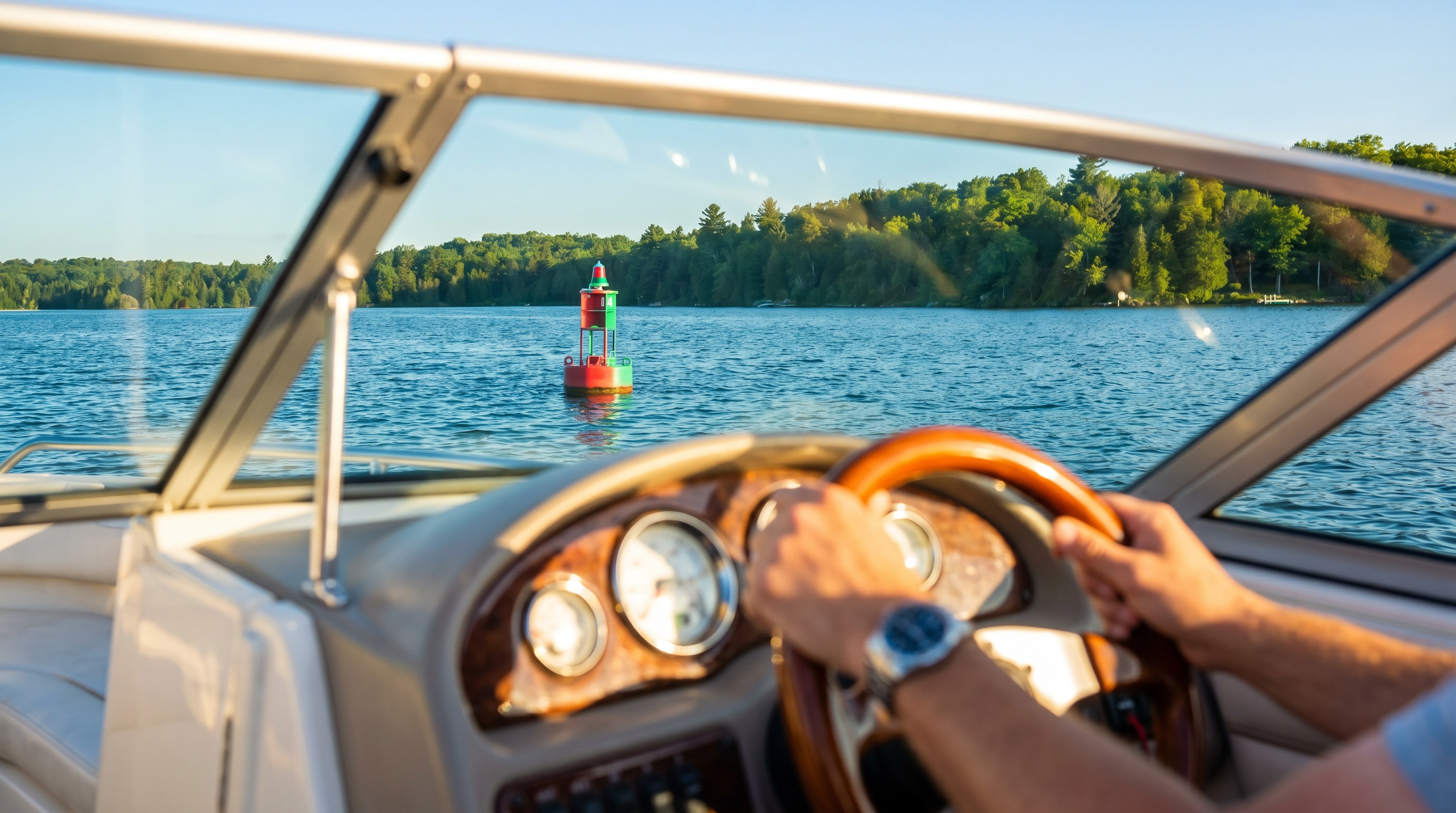
Do You Need a Boating Licence in Canada?
If you are planning to spend any time on the water this summer, you have probably asked yourself the big question: do you need a boating licence in Canada? The short answer is yes. If your boat has a motor, you need a licence.
Dwayne Rodrigues
Boat Owner & Enthusiast
 Safety
How to Avoid Running Aground: A Boater's Guide to Shallow Water Safety
Running aground is one of those boating experiences that ranges from a minor, face-reddening embarrassment to a catastrophic emergency. One minute you are cruising along enjoying the sun, and the next, there is a sickening crunch, a sudden stop, and every
Dwayne Rodrigues
Boat Owner & Enthusiast