Boating Accident Reports and Lessons: What Recent Years Have Taught Us
Every time you turn the key and hear that outboard rumble to life, you are taking on a massive responsibility. Most days on the water end with sunburns, empty coolers, and great memories. But when things go wrong out there, they go wrong fast.

Dwayne Rodrigues
Boat Owner & Enthusiast
Every time you turn the key and hear that outboard rumble to life, you are taking on a massive responsibility. Most days on the water end with sunburns, empty coolers, and great memories. But when things go wrong out there, they go wrong fast.
The 2024 and 2025 boating seasons brought some sobering reminders of just how unforgiving Canadian waters can be. From the tragic Bobs Lake collision that made national headlines to the quiet, preventable drownings that happen every weekend across Ontario, the data tells a very clear story.
We are going to look at the most recent boating accident reports, break down the hard numbers from Transport Canada and the OPP, and pull out the real-world lessons every boater needs to learn. Because honestly, reading about these incidents isn't about pointing fingers. It is about making sure you and your crew make it back to the dock safely every single time.
The Hard Numbers: 2024–2025 Boating Accident Statistics
If you want to understand what is actually happening on our lakes and rivers, you have to look at the data. The numbers from the last few years paint a picture that is both frustrating and entirely preventable.
According to the Drowning Prevention Research Centre, Canada sees an average of about 100 recreational boating-related deaths every single year. That makes up roughly 20% of all unintentional water-related fatalities in the country. And you know what? A staggering 90% of those recreational boating fatalities involve men.
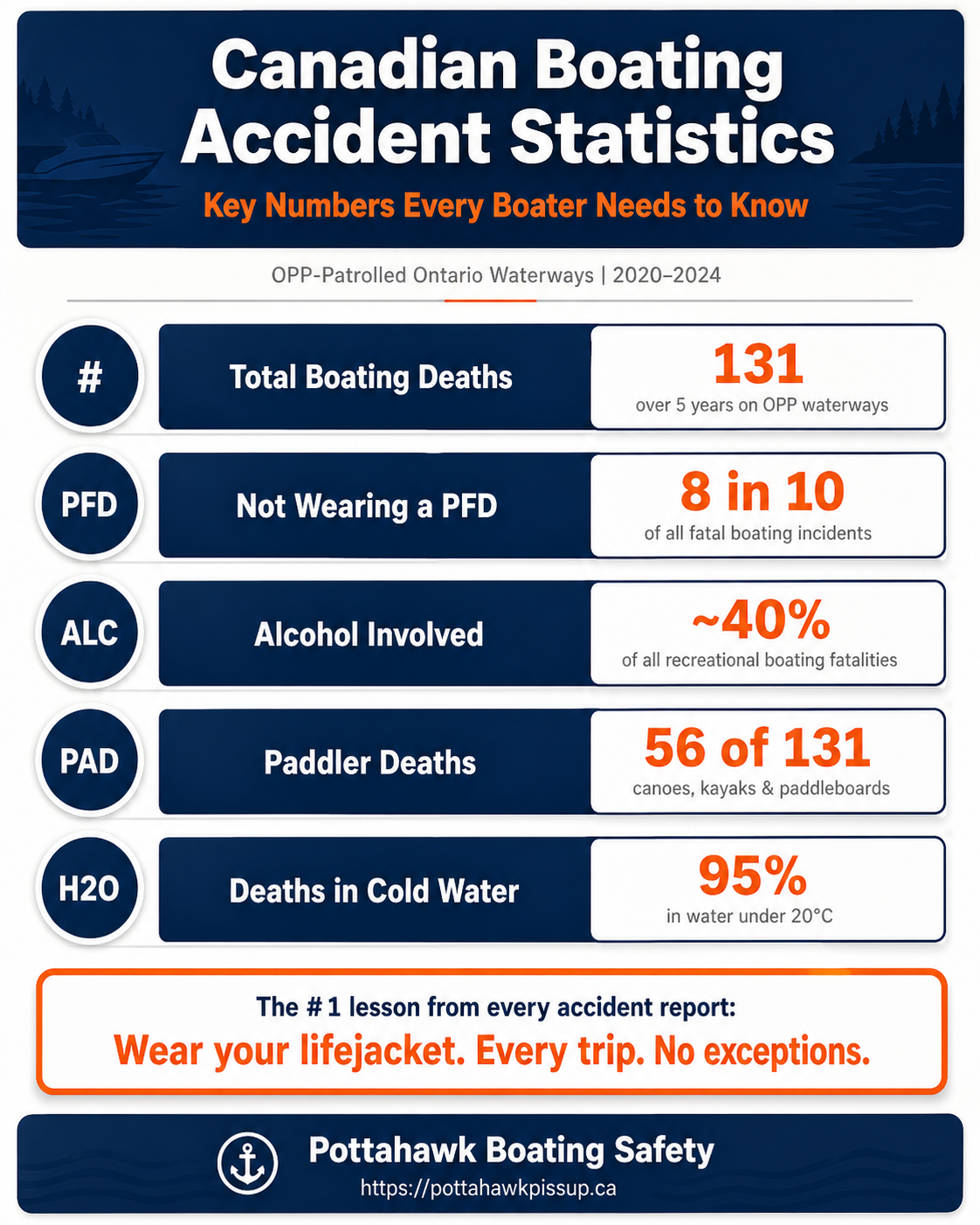
When we zoom in on Ontario, the Ontario Provincial Police (OPP) released a five-year data set covering 2020 to 2024. Over that period, 131 people lost their lives in boating incidents on OPP-patrolled waterways.
Here is the part that should make every boater stop and think: 8 out of 10 people who died in those fatal boating incidents were not wearing a personal flotation device (PFD).
Let that sink in. Eighty percent. The OPP marine unit has stated repeatedly that it is virtually impossible to drown if you are floating in the water with a properly fitted lifejacket. Even if you are knocked unconscious in a collision, a modern lifejacket will keep your head above water and keep you breathing. Yet, year after year, the vast majority of victims are found without one.
The Paddling Problem
It is not just the big powerboats getting into trouble. The OPP data revealed that 56 of those 131 deaths (about 43%) were paddlers. That includes 34 canoeists, 17 kayakers, and 5 people on stand-up paddleboards.
Many people grab a paddleboard or a kayak for a quick sunset paddle and think they do not need safety gear because they are not going fast or far. But the law is clear: whether you are in a 30-foot cruiser or on a paddleboard, you must have a lifejacket or PFD for every person on board. If you are caught without one, you are looking at a steep fine.
Case Study: The Bobs Lake Tragedy
To really understand how quickly a normal weekend can turn into a nightmare, we have to look at the Bobs Lake boat crash from May 2024. It is one of the most devastating recreational boating accidents in recent Ontario history, and it carries lessons every boater needs to hear.
It happened on the Victoria Day long weekend, the unofficial kickoff to the Canadian boating season. Just after 9:30 p.m. on May 18, 2024, a speedboat collided violently with a fishing boat in a narrow channel connecting Bobs Lake and Buck Bay, just north of Kingston.
The impact was catastrophic. Three young adults between the ages of 21 and 23, Riley Orr, Juliette Cote, and Kaila Bearman, were killed instantly at the scene. Five other people, ranging in age from 21 to 44, were injured and rushed to the hospital.
Emergency dispatch recordings from that night captured the chaos, with first responders arriving to find victims wedged together on the boats next to a concrete dock. Local cottagers ran out in the dark to help however they could, but the damage was already done.
The Charges and the Lessons
Following a massive, months-long investigation by the OPP, charges were finally laid in October 2024. The driver of the speedboat was charged with three counts of dangerous operation causing death, three counts of dangerous operation causing bodily harm, three counts of impaired operation causing death, and three counts of impaired operation causing bodily harm. His trial is set for April 2027.
But the investigation did not stop there. A second man, someone on the fishing boat that was struck was also charged under the Canada Shipping Act. His charges included failing to exhibit a stern light on a power-driven vessel underway, failing to exhibit sidelights, and operating a pleasure craft without a PFD or lifejacket of appropriate size for each person on board.
This tragedy highlights a perfect storm of the three deadliest factors in recreational boating: night navigation without proper lighting, the absence of lifejackets, and suspected alcohol impairment.
When you are operating a boat at night, your navigation lights are the only thing keeping you visible to other vessels. If your lights are off or broken, you are essentially a ghost on the water. Combine that invisibility with speed and alcohol, and the results are almost always fatal.
The Top 3 Causes of Boating Fatalities
When you look at the national reports from the Lifesaving Society and Transport Canada, the same three factors show up in almost every fatal accident report. If you can eliminate these three risks from your boat, your chances of a safe return go up exponentially.
1. Not Wearing a Lifejacket
We already covered the OPP statistic, but it bears repeating. Over 80% of boating fatality victims were not wearing a PFD. Keeping a lifejacket stuffed under a seat or in a storage locker does not count. When a boat capsizes or you are thrown overboard in a collision, you will not have the time or the coordination to find your lifejacket, pull it out, and put it on while treading water.
If you hate the bulky orange vests, invest in a modern, low-profile inflatable PFD. They are so comfortable you will forget you are wearing them, and they meet the new Canadian lifejacket standards perfectly.
2. Alcohol Consumption
Roughly 40% of individuals who are fatally injured in recreational boating incidents had consumed alcohol.
There is a massive misconception out there that drinking on a boat is somehow different or safer than drinking behind the wheel of a car. It is not. In fact, the sun, wind, glare, and constant motion of the boat create a condition known as "boater fatigue." This fatigue can actually amplify the effects of alcohol by up to four times.
The laws in Ontario are incredibly strict. Drinking while boating carries the exact same penalties as drinking and driving. If you are caught operating a boat while impaired, you will lose your driver's licence for your car, face massive fines, and potentially see jail time. You can only consume alcohol on a boat if it has permanent sleeping, cooking, and washroom facilities, AND it is securely anchored or docked.
3. Cold Water Shock and Hypothermia
Canada has a lot of water, and most of it is freezing cold for the majority of the year. According to the Drowning Prevention Research Centre, 50% of recreational boating deaths occur in very cold water (under 10 degrees Celsius), and another 45% occur in cold water (10 to 20 degrees Celsius). Only 5% of fatalities happen in warm water.
When you fall into cold water, your body's first involuntary reaction is a sudden, massive gasp for air. If your head is underwater when that gasp happens, you will inhale water and drown immediately. This is known as cold water shock.
If you survive the initial shock, hypothermia sets in rapidly. Within minutes, you lose the dexterity in your hands and arms, making it impossible to swim or pull yourself back into the boat. This is exactly why knowing how to avoid running aground and staying in the boat is so critical during the shoulder seasons.
The Commercial Side: TSB Marine Occurrences
While recreational boaters make up the bulk of the fatalities, the commercial sector has its own challenges. The Transportation Safety Board of Canada (TSB) tracks all commercial marine occurrences, and their 2024 data offers some interesting context.
In 2024, there were 213 marine accidents reported to the TSB, which is actually down from the 10-year average. However, there were still 12 marine fatalities, and half of those involved commercial fishing vessels.
The most frequent types of shipping accidents were collisions (34%), groundings (26%), and fires or explosions (20%). Even the professionals, with all their training and advanced radar systems, still run into each other and run aground. It is a humbling reminder that the water does not care how much experience you have. If you lose focus, things go wrong.
Lessons Learned: How to Protect Your Crew
So, what do we take away from all these grim statistics and tragic case studies? How do we make sure we are not a statistic in the 2026 report?
1. Make Lifejackets Mandatory on Your Boat As the captain, you set the rules. Make it a strict policy that everyone wears a PFD while the boat is underway. If you are heading to a massive raft-up like Pottahawk, make sure your crew knows the rules before they step on board.
2. Check Your Lights Before Dark The Bobs Lake crash is a terrifying example of what happens when boats operate in the dark without proper lighting. Before you leave the dock for an evening cruise, physically check that your red and green sidelights and your white all-around stern light are working. Carry spare bulbs and fuses.
3. Save the Drinks for the Dock It is really that simple. Designate a sober captain just like you would designate a sober driver. The water is unpredictable enough without adding delayed reaction times and impaired judgment to the mix.
4. Get Your Licence and Know the Rules Operator inexperience is a massive factor in many accidents. If you do not have your Pleasure Craft Operator Card (PCOC) yet, get it. Do you need a boating licence in Canada? Yes, absolutely. It is the law, and the course actually teaches you the right-of-way rules that prevent collisions.
5. Carry Proper Insurance While boat insurance is not legally required in Ontario, operating without it is a massive financial risk. If you cause an accident that results in injuries or property damage, you are personally liable. A good policy protects you, your passengers, and your assets.
The Bottom Line
Boating is supposed to be fun. It is supposed to be an escape from the stress of daily life. But that escape requires a foundation of respect for the water and the rules that govern it.
The accident reports from 2024 and 2025 are not just numbers on a page. They are real people who went out for a good time and never came home. Learn from their tragedies. Wear your lifejacket, stay sober at the helm, check your lights, and keep your head on a swivel.
The water is waiting. Let's make sure we all get to enjoy it safely this season.
Sources & Further Reading
Drowning Prevention Research Centre, "Recreational Boating-Related Fatalities in Canada"
Ontario Provincial Police, "No lifejacket worn in 8 of 10 boating fatalities, OPP warn" (May 2025)
Global News, "Trial date set for man facing charges in deadly Ontario boat crash" (March 2026)
Transportation Safety Board of Canada, "Marine transportation occurrences in 2024"
Tags
Share
Read Next
 News
NewsThe WAHVA Surcharge: Transport Canada's Crackdown on Abandoned Boats
Honestly, when was the last time you thought about your Pleasure Craft Licence? For most of us, it’s a piece of paper (or plastic) we got years ago, tucked away in a folder somewhere. But a small change is coming that you’ll definitely notice on your next

Dwayne Rodrigues
Boat Owner & Enthusiast
 News
NewsThe New 2025/2026 Lifejacket Standards: What "Level 70" Means for Your Next PFD
It’s that time of year again. You’re pulling the boat out of storage, dusting off the coolers, and dreaming of those long summer days on Lake Erie. But before you even think about launching, you head to the store for the annual pre-season stock-up.
Dwayne Rodrigues
Boat Owner & Enthusiast
 News
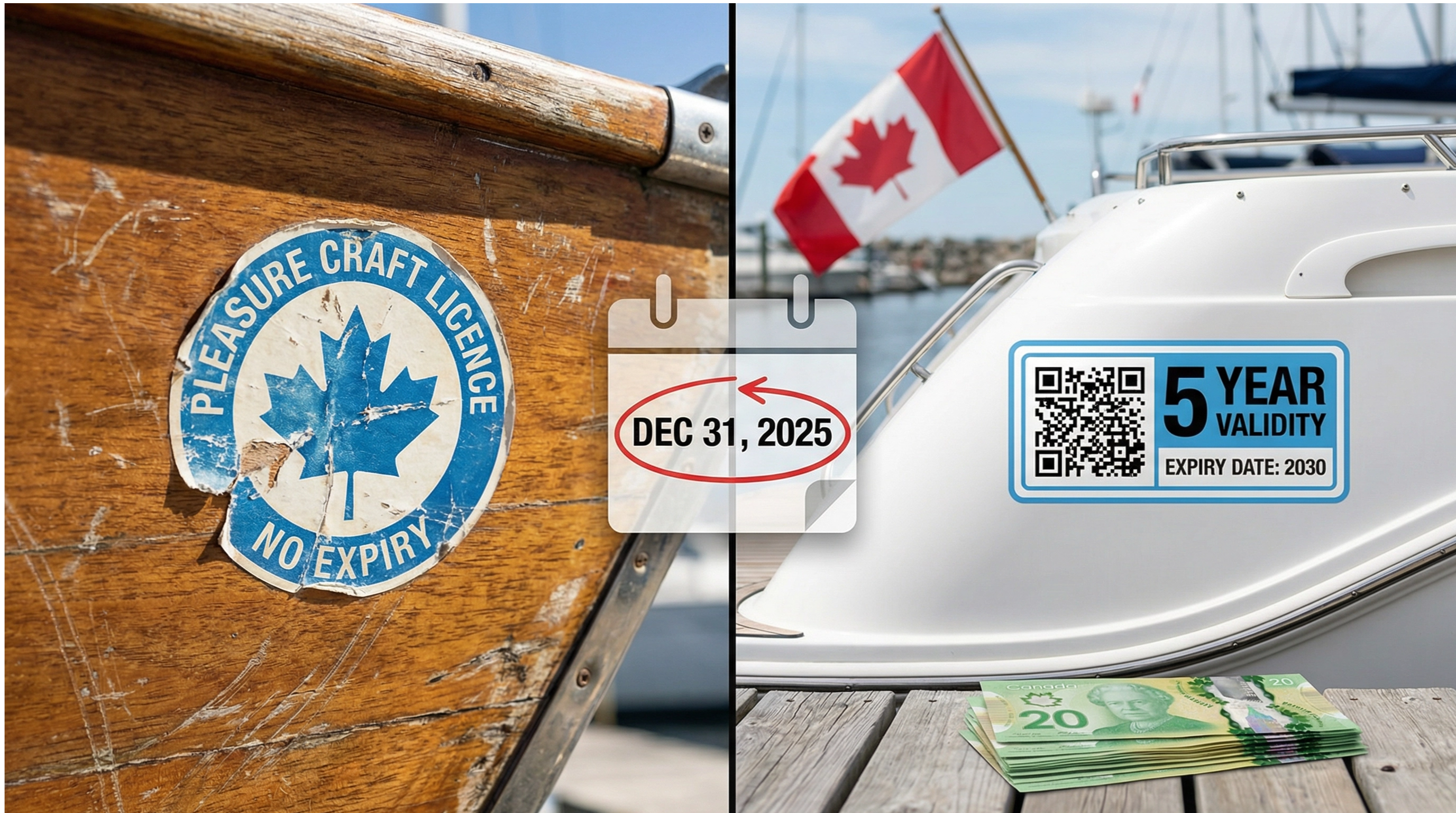
NewsIs Your Boat Licence Expiring? The New 2026 Rules That Could Cost You a Fine
Remember when your Pleasure Craft Licence (PCL) was free and lasted pretty much forever? Well, those days are officially over. As of December 31, 2025, Transport Canada rolled out a whole new set of rules, and if you haven’t heard about them, you’re not
Dwayne Rodrigues
Boat Owner & Enthusiast