Transport Canada Boating Rules: The Complete Guide
Navigating the waters of Canada offers some of the most spectacular recreational boating in the world, from the vast expanses of the Great Lakes to the intricate networks of coastal inlets. However, this privilege comes with a profound responsibility.

Dwayne Rodrigues
Boat Owner & Enthusiast
Quick Takeaways
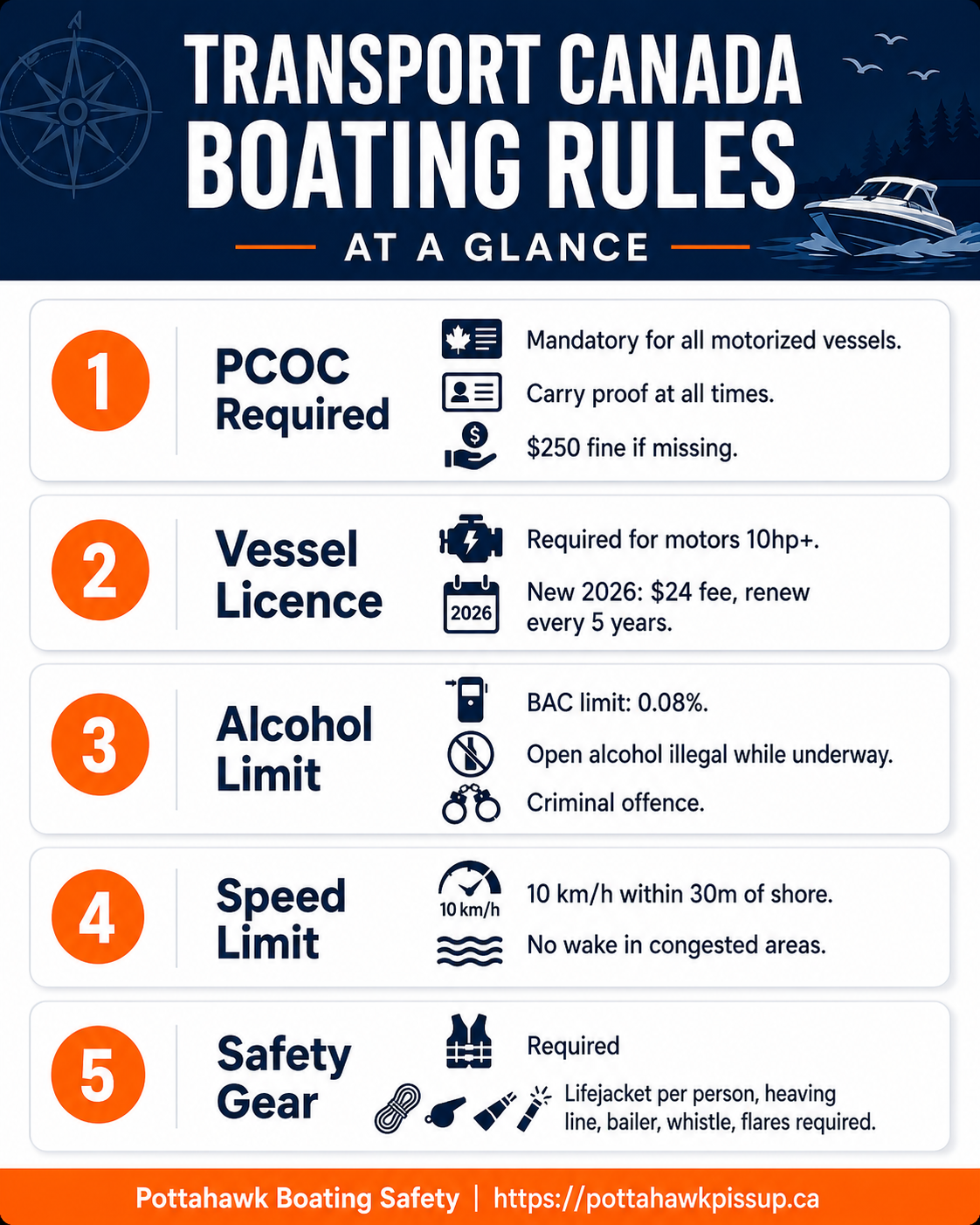
PCOC Requirement: Mandatory for anyone operating a motorized recreational vessel in Canada, regardless of age or engine size.
2026 Licence Changes: Pleasure Craft Licences now cost $24, must be renewed every 5 years, and old "lifetime" licences are expiring.
Alcohol Limits: The legal blood alcohol limit for boating is 0.08%, identical to driving a car. Open alcohol is illegal while underway.
Safety Equipment: Minimum requirements include a Canadian-approved lifejacket for every person, a 15m heaving line, a bailer, and a sound-signalling device.
Speed Limits: The unposted speed limit is 10 km/h within 30 metres of the shore in most Canadian provinces.
Navigating the waters of Canada offers some of the most spectacular recreational boating in the world, from the vast expanses of the Great Lakes to the intricate networks of coastal inlets. However, this privilege comes with a profound responsibility. Transport Canada, the federal department responsible for transportation policies and programs, enforces a strict set of regulations designed to keep everyone safe on the water. Whether you are a seasoned captain or preparing to launch your first pontoon boat, understanding Transport Canada boating rules is not just a legal obligation, it is the foundation of responsible seamanship. If you are brand new to boating, our Beginner's Guide to Boating in Canada is a great place to start before working through the regulations in detail here.
The regulatory landscape for Canadian boaters is comprehensive, governed primarily by the Canada Shipping Act, 2001 and the Criminal Code of Canada . These frameworks dictate everything from the mandatory safety equipment you must carry to the strict penalties for operating a vessel under the influence of alcohol or drugs. Recently, significant updates have been introduced, particularly regarding vessel licensing, making it more critical than ever to stay informed.
This complete guide breaks down the essential Transport Canada boating rules you need to know. We will explore the requirements for the Pleasure Craft Operator Card (PCOC), detail the new 2026 Pleasure Craft Licence regulations, outline mandatory safety gear, clarify right-of-way protocols, and explain the severe consequences of impaired boating. By mastering these regulations, you ensure that your time on the water remains safe, enjoyable, and entirely compliant with Canadian law.
The Pleasure Craft Operator Card (PCOC) Explained
The most fundamental requirement for recreational boaters in Canada is the Pleasure Craft Operator Card, commonly referred to as a boating licence. Transport Canada mandates that anyone operating a motorized recreational vessel must carry proof of competency on board at all times. This rule applies universally, regardless of the operator's age, the length of the boat, or the size of the engine. Even if you are simply operating a small dinghy with an electric trolling motor, you must have a valid PCOC.
Obtaining a PCOC involves taking a Transport Canada-approved boating safety course and passing a standardized test. The course covers essential topics such as navigation rules, buoy identification, emergency response procedures, and the specific regulations outlined in the Canada Shipping Act, 2001. Once issued, the PCOC is valid for life and does not require renewal. However, you must carry the physical card, or an approved electronic version whenever you are operating a vessel. Failure to produce your PCOC when requested by law enforcement carries a standard fine of $250. For a full walkthrough of how to obtain your PCOC and what the test covers, see our Beginner's Guide to Boating in Canada.
There are a few specific exemptions to the PCOC requirement. Non-residents operating their own boat in Canadian waters for less than 45 consecutive days are not required to hold a Canadian PCOC, provided they comply with the boating education requirements of their home state or country. However, if a non-resident is renting a boat in Canada or operating a Canadian-registered vessel, they must provide proof of competency, which can often be satisfied by completing a rental boat safety checklist provided by the outfitter.
Age and Horsepower Restrictions
While the PCOC is required for all operators of motorized vessels, Transport Canada also enforces strict age and horsepower restrictions to ensure that young boaters do not operate vessels beyond their capability to manage safely. These restrictions are designed to protect both the youth operating the boat and other individuals sharing the waterway.
The regulations establish clear boundaries based on the age of the operator. Children under the age of 12 who are not directly supervised by someone 16 years of age or older may only operate boats with motors of up to 10 horsepower (7.5 kW). This allows young boaters to gain experience in small, low-powered craft, such as a basic aluminum fishing boat with a small outboard motor.
For youths between the ages of 12 and 15 who are operating a vessel without direct supervision from someone 16 or older, the maximum allowable engine power increases to 40 horsepower (30 kW). This provides a stepping stone for teenagers to handle slightly larger vessels while still restricting access to high-performance boats.
Perhaps the most critical restriction applies to Personal Watercraft (PWCs), commonly known by brand names like Sea-Doo or Waverunner. Transport Canada explicitly prohibits anyone under the age of 16 from operating a PWC under any circumstances, even if they are directly supervised by an adult. The high speed, rapid acceleration, and unique handling characteristics of PWCs require a level of maturity and physical strength that younger operators typically do not possess. Once an individual reaches 16 years of age, there are no horsepower restrictions, provided they hold a valid PCOC.
The New 2026 Pleasure Craft Licence Rules
A Pleasure Craft Licence (PCL) is a unique identification number assigned to a specific vessel, much like a licence plate on a car. Transport Canada requires a PCL for all pleasure craft equipped with motors of 10 horsepower (7.5 kW) or more. The licence number must be displayed on both sides of the boat's bow in a contrasting colour, with characters at least 7.5 centimetres (3 inches) high, ensuring visibility for law enforcement and search and rescue operations.
Historically, obtaining a PCL was free, and the licence was valid for the lifetime of the vessel. However, significant regulatory changes have been implemented, fundamentally altering how Canadian boaters manage their vessel documentation. As detailed in our comprehensive guide on the new 2026 boat licence rules, Transport Canada has introduced a fee structure and mandatory renewal cycles to improve the accuracy of the national vessel registry.
Under the new regulations, it now costs $24 to issue, renew, or transfer a Pleasure Craft Licence. Furthermore, all new and renewed licences are only valid for a period of five years. Perhaps the most impactful change affects boaters who hold older "lifetime" licences. These legacy documents now have firm expiry dates. For example, if your licence was issued before January 1, 1975, it expires on March 31, 2026. Licences issued in subsequent decades have staggered expiry dates rolling out through 2030.
Boaters must also be diligent about keeping their information current. The new rules stipulate that you have only 30 days to update your name or address with Transport Canada if you move or sell the vessel. Failing to maintain an active, accurate PCL can result in significant fines, making it essential to check your documentation and understand your specific renewal deadline.
Mandatory Safety Equipment for Canadian Boaters
Transport Canada's Small Vessel Regulations outline the minimum mandatory safety equipment that must be carried on board every recreational vessel. The specific requirements vary depending on the length and type of the boat, but the underlying principle remains constant: you must be prepared to handle emergencies, signal for help, and keep your passengers afloat.
For a standard motorized pleasure craft up to 6 metres (19.7 feet) in length, the baseline required equipment includes:
Personal Flotation Devices (PFDs): One Canadian-approved lifejacket or PFD of the appropriate size for every person on board. While the law only requires them to be accessible, safety experts strongly advocate wearing them at all times, as the majority of boating fatalities involve individuals who were not wearing a lifejacket when they entered the water.
Buoyant Heaving Line: A floating rope at least 15 metres (49 feet 3 inches) in length, used to pull a person in the water back to the boat [3].
Manual Propelling Device or Anchor: Either a paddle/oar or an anchor equipped with at least 15 metres of cable, rope, or chain.
Bailer or Manual Bilge Pump: A device to remove water from the hull.
Sound-Signalling Device: A pealess whistle or a compressed gas horn to signal intentions or distress.
Navigation Lights: Required if the vessel is operated after sunset, before sunrise, or in periods of restricted visibility (such as fog or heavy rain).
Fire Extinguisher: A Class 5BC fire extinguisher is mandatory if the boat is equipped with an inboard engine, a fixed fuel tank, or any fuel-burning appliance.
Visual Distress Signals: Either a watertight flashlight or three Transport Canada-approved flares (Type A, B, or C). Notably, Transport Canada now accepts approved Electronic Visual Distress Signals (eVDSD) in lieu of traditional pyrotechnic flares on pleasure craft, offering a safer and longer-lasting alternative.
Before heading out, it is crucial to consult the Lake Erie Boating Safety Guide and complete a thorough Pre-Trip Inspection Checklist to ensure all required gear is present, accessible, and in good working condition.
Alcohol, Drugs, and Boating Under the Influence (BUI)
One of the most critical areas of enforcement under Transport Canada and the Criminal Code of Canada involves the consumption of alcohol and drugs while boating. The laws governing Boating Under the Influence (BUI) are stringent and carry severe consequences, reflecting the immense danger that impaired operation poses on the water.
In Canada, operating a boat while impaired by alcohol or drugs is a criminal offence, treated with the exact same severity as driving a car while impaired. The legal Blood Alcohol Concentration (BAC) limit for operating a vessel is 0.08% (80 milligrams of alcohol in 100 millilitres of blood). However, many provinces enforce immediate roadside or waterside licence suspensions for boaters caught in the "warn range," typically between 0.05% and 0.08%.
Furthermore, it is illegal to consume alcohol on a boat while it is underway. Open alcohol containers are strictly prohibited while the vessel is in motion. There is a specific, narrow exception that allows passengers to legally consume alcohol on board, but the vessel must meet all of the following criteria simultaneously:
The boat must be equipped with permanent cooking facilities.
The boat must be equipped with permanent sleeping facilities.
The boat must be equipped with a permanent toilet.
The boat must be securely anchored or tied alongside a dock.
If your vessel does not meet these requirements, which excludes the vast majority of day cruisers, bowriders, and fishing boats, alcohol consumption is entirely prohibited. The penalties for BUI are severe, including hefty fines, the suspension of your driver's licence (in many provinces, a BUI affects your ability to drive a car), vessel impoundment, and potential imprisonment for repeat offences or incidents causing injury or death. It is also worth noting that cold water dramatically accelerates the effects of alcohol on the body something every Great Lakes boater should understand before heading out in spring or fall. Our post on Cold Water Boating Risks on the Great Lakes covers this in detail.
Speed Limits and Safe Operation
While the open water might seem like an invitation to push the throttle, Transport Canada enforces specific speed limits and operational standards to protect shorelines, wildlife, and other waterway users. The most universal restriction is the unposted shoreline speed limit.
In the provinces of Ontario, Manitoba, Saskatchewan, Alberta, British Columbia, and Nova Scotia, there is a mandatory, unposted speed limit of 10 km/h (6 mph) when operating within 30 metres (100 feet) of the shore. This rule is designed to minimize wake damage to docks and moored vessels, protect swimmers, and reduce the risk of collisions in shallow, congested areas.
There are a few exceptions to this shoreline speed limit. It does not apply when a boat is pulling a water-skier perpendicularly away from the shore, when operating in rivers or canals that are less than 100 metres wide, or when navigating within clearly marked buoyed channels.
Beyond specific speed limits, the Criminal Code of Canada explicitly prohibits operating a vessel in a manner that is dangerous to the public. Excessive speed in shallow or unfamiliar waters is also one of the leading causes of groundings, a situation that can quickly become a safety emergency. Our guide on How to Avoid Running Aground covers the practical steps every boater should take. This encompasses a wide range of reckless behaviours, including excessive speeding in crowded anchorages, intentionally spraying other boats with wake, or operating a vessel that is in an unseaworthy condition. Boaters are expected to maintain a safe speed at all times, adjusting for visibility, traffic density, wind, and water conditions.
Right of Way: The Collision Regulations
Understanding who has the right of way is essential for preventing accidents, particularly in busy channels or popular destinations like Long Point Bay. Transport Canada adheres to the international Collision Regulations, which establish a clear hierarchy of vessels and specific rules for how boats should interact when their paths cross.
The regulations define a priority system based on a vessel's ability to manoeuvre. Recreational powerboats, being the most agile, generally sit at the bottom of this hierarchy and must give way to almost all other traffic. The priority order, from highest to lowest, is as follows:
Vessel Not Under Command: A boat that has lost steering or engine power and cannot manoeuvre.
Restricted in Ability to Manoeuvre: Vessels engaged in complex operations like dredging, cable-laying, or underwater construction.
Constrained by Draught: Large commercial ships that can only navigate safely within a deep, narrow channel.
Fishing Vessel with Gear Deployed: Commercial fishing boats actively using nets or trawls (this does not apply to recreational anglers with a single line).
Sailing Vessel: A boat operating under sail power alone, with its engine turned off.
Power-Driven Vessel: Any boat propelled by machinery, including sailboats using their engines.
When two power-driven vessels encounter each other, specific rules dictate the required action. In a head-on situation, both vessels must alter their course to starboard (the right), passing port-to-port. In a crossing situation, the vessel that has the other on its starboard (right) side is the "give-way" vessel and must alter course or slow down to avoid a collision. The other boat is the "stand-on" vessel and should maintain its course and speed. When overtaking another boat, the overtaking vessel must keep clear of the vessel being passed, regardless of whether it passes on the port or starboard side.
For a deeper dive into navigating complex waterways and understanding the buoy systems that mark safe channels, refer to our comprehensive guide on Navigating Like a Pro.
Rules for Towing Water-Skiers and Wakeboarders
Towing water-skiers, wakeboarders, or individuals on inflatable tubes is a quintessential part of Canadian summer boating. However, these activities introduce significant risks, and Transport Canada has established specific regulations to ensure they are conducted safely.
The most critical rule involves the requirement for a dedicated spotter. The Criminal Code of Canada mandates that whenever a person is being towed, there must be a person on board the vessel, other than the operator, who is actively keeping watch of the individual being towed. The operator's primary responsibility is to navigate the boat safely, while the spotter communicates with the skier and alerts the operator immediately if the skier falls.
Furthermore, the towing vessel must have adequate seating capacity. There must be an empty seat available on the boat for every person being towed. This ensures that if the activity must be aborted, or if the weather turns dangerous, all individuals in the water can be safely brought aboard without exceeding the vessel's maximum capacity.
Finally, towing activities are strictly limited by time of day. It is prohibited to tow water-skiers or wakeboarders from one hour after sunset until sunrise. The reduced visibility during these hours makes it exceptionally difficult for the operator to see hazards in the water and nearly impossible for other boaters to spot a fallen skier.
Enforcement and Penalties on the Water
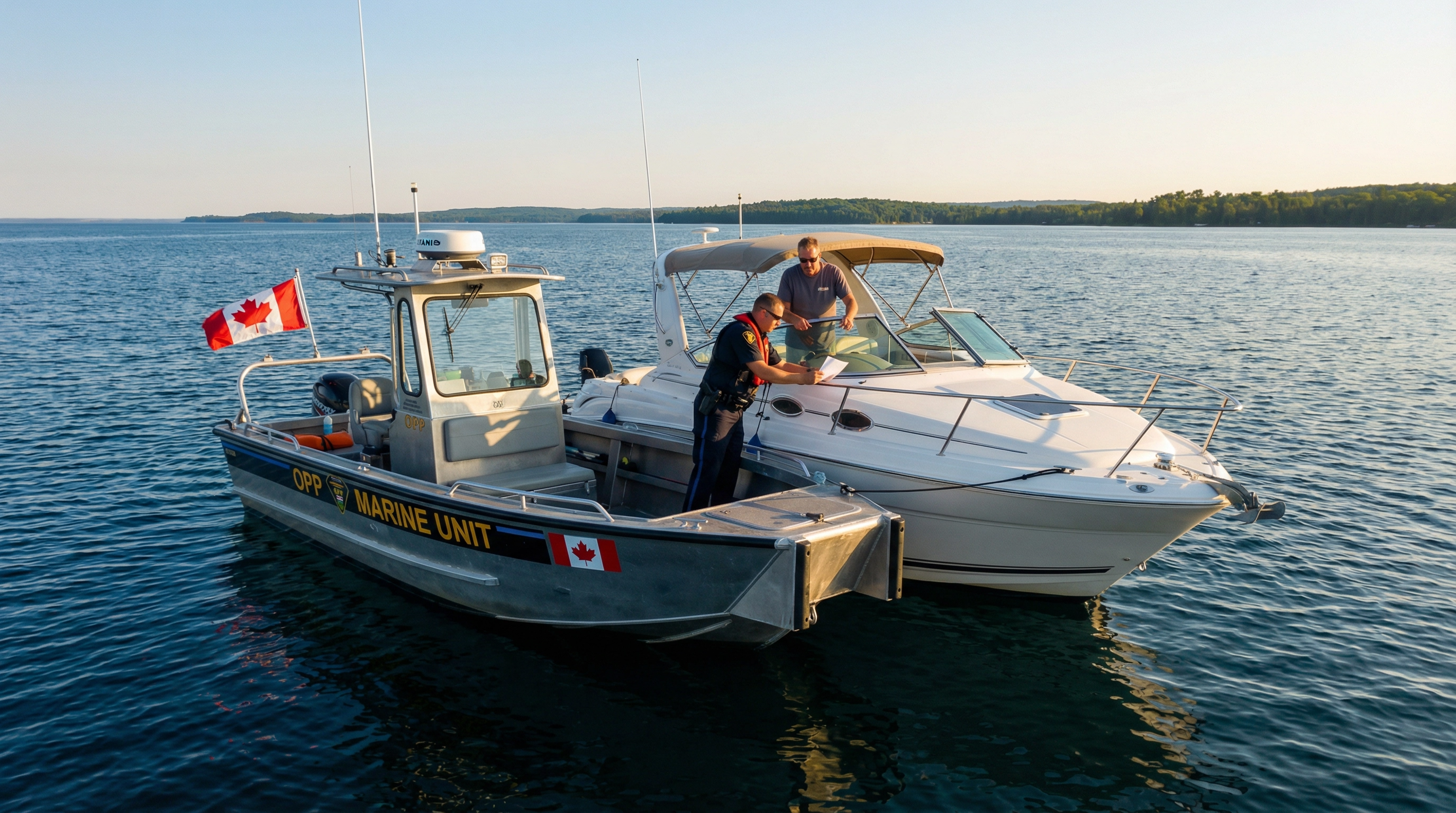
The enforcement of Transport Canada boating rules is a collaborative effort involving multiple agencies. On the water, you may encounter officers from the Royal Canadian Mounted Police (RCMP), provincial police forces (such as the Ontario Provincial Police marine units), municipal police, and conservation officers. These authorities have broad powers to ensure compliance and maintain public safety.
Law enforcement officers are authorized to stop and board your vessel at any time to conduct a safety inspection. During these checks, they will verify that you hold a valid Pleasure Craft Operator Card, that your vessel is properly licensed, and that you are carrying all mandatory safety equipment in good working order. They also actively monitor for signs of impaired operation and reckless behaviour.
The penalties for violating Transport Canada regulations range from substantial fines to criminal charges. Failing to carry your PCOC or lacking required safety gear typically results in fines starting at $250 per infraction. More severe violations, such as operating an unseaworthy vessel, interfering with navigation aids, or failing to assist another boater in distress, can lead to significant financial penalties and potential imprisonment under the Criminal Code of Canada.
Ultimately, these rules are not designed to restrict your enjoyment of the water, but to ensure that every boater returns to the dock safely at the end of the day. If you are planning a longer voyage across the lake, be sure to read our complete guide on Crossing Lake Erie Safely, which covers CBSA reporting requirements, fuel planning, and weather preparation for the full crossing. By understanding and adhering to Transport Canada's regulations, you contribute to a culture of responsibility and respect that benefits the entire boating community.
Frequently Asked Questions (FAQ)
Do I need a boating licence for an electric trolling motor in Canada? Yes. Transport Canada requires a Pleasure Craft Operator Card (PCOC) for anyone operating a vessel fitted with any type of motor, including small electric trolling motors, regardless of the engine's horsepower.
Can I drink alcohol on my boat if I am anchored? You can only consume alcohol on an anchored boat if the vessel meets three specific criteria: it must have permanent cooking facilities, permanent sleeping facilities, and a permanent toilet. If your boat lacks any of these, open alcohol is illegal, even at anchor.
What is the fine for not having a Pleasure Craft Operator Card? If you are caught operating a motorized recreational vessel without carrying your valid Pleasure Craft Operator Card (or approved electronic proof), you face a standard fine of $250.
Do I have to renew my Pleasure Craft Licence? Yes. Under the new 2026 regulations, all Pleasure Craft Licences must be renewed every five years, and there is a $24 fee for issuance, renewal, or transfer. Old "lifetime" licences are currently expiring based on a staggered schedule.
What safety equipment is required on a 16-foot powerboat? For a standard powerboat under 6 metres, you must carry a Canadian-approved lifejacket for each person, a 15m buoyant heaving line, a manual propelling device or anchor, a bailer, a sound-signalling device, a watertight flashlight or three approved flares, and a fire extinguisher (if the boat has an inboard engine or fixed fuel tank).
Who has the right of way between a sailboat and a powerboat? According to the Collision Regulations, a power-driven vessel must give way to a sailing vessel that is operating under sail power alone. However, if the sailboat has its engine turned on, it is considered a power-driven vessel and must follow standard powerboat right-of-way rules.
Is it legal to tow a water-skier without a spotter? No. The Criminal Code of Canada explicitly requires a dedicated spotter—a person other than the operator—to keep watch of anyone being towed behind a vessel.
Sources & Further Reading
Tags
Share
Read Next
 Resources
Boat Insurance in Ontario: What It Covers, What It Costs, and What Most Boaters Get Wrong
Let me ask you a question. If you back your boat into a slip at Port Dover and accidentally crunch the fiberglass on the cruiser next to you, who pays for it? What if a sudden summer squall rips through the anchorage at Pottahawk and your anchor drags,

Dwayne Rodrigues
Boat Owner & Enthusiast
 Resources
How to Summerize Your Boat: The Complete Spring Checklist for Canadians
There is a specific feeling that hits every Canadian boater around late April or early May. The ice has finally melted off Lake Erie, the sun is starting to feel genuinely warm, and you catch yourself staring at the boat trailer in the driveway. You know
Dwayne Rodrigues
Boat Owner & Enthusiast
 Resources
Fuel Planning for a Long Weekend: How to Never Get Stranded on the Water
That quiet, creeping anxiety is something almost every boater has felt at some point. Running out of fuel on the water is not just embarrassing. It's genuinely dangerous. You lose steerage, you lose the ability to respond to changing weather, and you becom
Dwayne Rodrigues
Boat Owner & Enthusiast